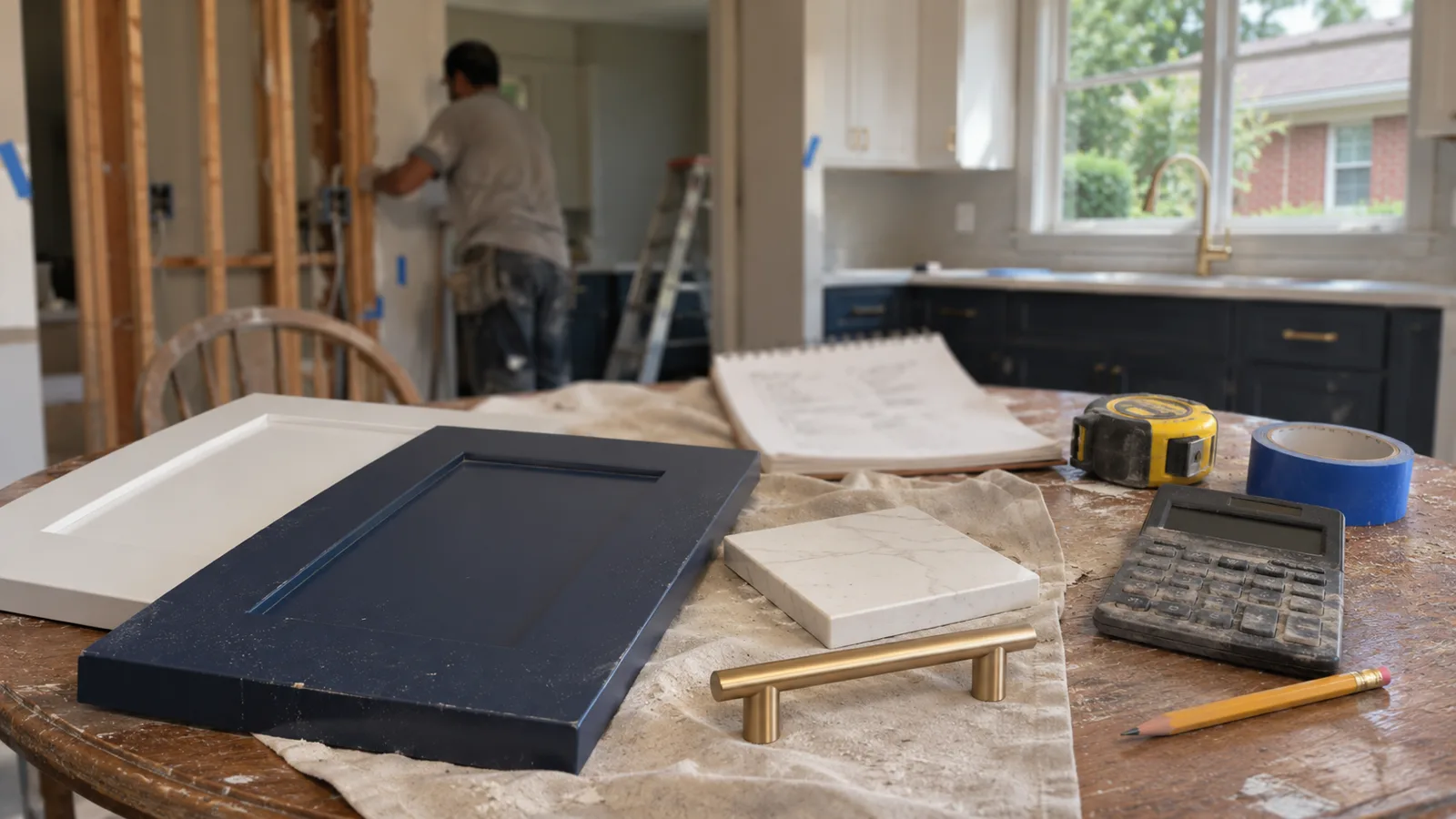
Southern Humidity + Kitchen Materials: What Holds Up in Georgia Heat
Gwinnett County humidity sits above 70% nine months a year and that destroys bad kitchen materials by year 2. Here is what we have watched hold up and fail across 50+ Lawrenceville remodels.
Published · By Carlos Mendoza
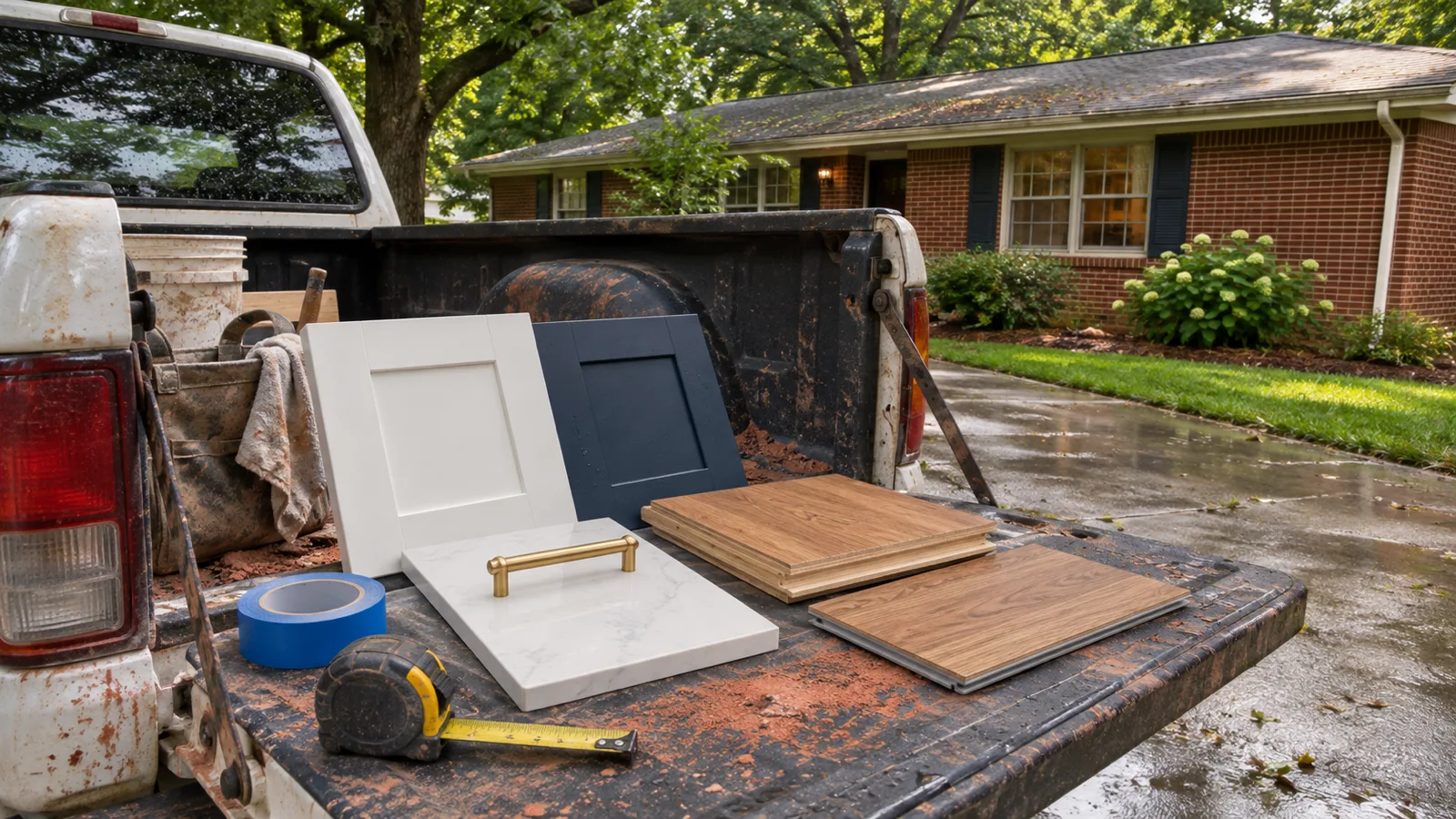
Gwinnett County humidity averages 72 to 85% inside a Lawrenceville home for roughly nine months of the year. That is enough moisture to swell particle-board cabinets, pop thermofoil door seams, mold standard grout and cup glued-down engineered hardwood. Material choice matters here more than in a drier climate. Here is what we have seen hold up and fail across 50+ Lawrenceville kitchen remodels since the company opened.
Cabinet boxes: plywood, not particle board
Particle board is the most common cabinet box in big-box stock sets. In a Lawrenceville kitchen, particle-board boxes swell at the back seam within 18 to 24 months because of ambient humidity cycling. The sink base is worst: any slow supply-line leak will disintegrate a particle-board bottom inside a season. We have replaced particle-board sink bases on 30+ Lawrenceville homes and almost every one had a leak the homeowner did not know about until they smelled it.
Plywood boxes cost about 15% more and last 4x as long in Georgia humidity. The seams do not swell, the sink base will tolerate a leak long enough to spot the problem, and plywood holds screws much better over time. We spec plywood on every install. If a big-box store tries to upsell a 'solid wood' box that is still particle board core, ask to see the cross-section. If the edge is not a clean plywood lamination pattern, it is particle board with a veneer wrap.
Cabinet doors: solid wood, not thermofoil
Thermofoil doors are vinyl wrapped over MDF, and they look fine for the first few years. In a Lawrenceville kitchen the heat and steam cycling near the range and dishwasher cooks the vinyl seams loose, usually at the edges first. We have replaced thermofoil doors on 12 Lawrenceville kitchens where the original install was less than 6 years old. The failure is cosmetic, not structural, but it is also not repairable without full door replacement.
Solid wood doors (paint-grade poplar, stain-grade maple or oak) hold up indefinitely if the finish is sealed and the climate stays reasonable. We default to painted solid-wood shaker doors on Lawrenceville kitchens and have never had a material failure on one.
Counters: quartz beats granite in 2026
Granite was the default Lawrenceville kitchen counter from 1998 to about 2015, so we tear out a lot of granite on remodel jobs. The common failures: sealer wearing through in the sink zone (water stains and etching), hairline cracks from a settled cabinet run that was never leveled, and butt-seam gaps where the installer cheaped out on epoxy fill. Granite needs resealing every 2 to 4 years in Lawrenceville, which almost nobody does.
Quartz is engineered stone and does not need sealing. It handles Georgia humidity without any care. The price gap between mid-range granite and mid-range quartz has closed to $400 to $900 for a typical Lawrenceville kitchen in 2026. We install quartz on about 75% of the Lawrenceville kitchens we remodel now, and the trend is still growing.
Butcher block works on islands and prep sections if finished with food-safe mineral oil and re-oiled every few months. It does not work near the dishwasher in Lawrenceville humidity because the steam cycling warps the edge grain.
Hardware: solid brass or marine 316 stainless
Standard chrome hardware is fine for the Collins Hill, Pike Road and Bethesda interior-stock Lawrenceville homes that are not near open water. Chrome plating holds up for 10+ years in moderate humidity.
Standard stainless hardware is almost identical in lifespan. Both are fine indoors in Lawrenceville.
Where it matters: Berkeley Lake homes with lakefront exposure see higher moisture pressure and can benefit from solid brass with PVD finish or marine 316 stainless. Not a Lawrenceville-proper issue, but we flag it for the ring of homes closest to the lake.
Backsplash: epoxy grout, not sanded
Sanded grout is the standard on 80% of big-box backsplash installs. In a Lawrenceville kitchen the grout seams near the range and dishwasher mold within 2 years and stain permanently from tomato sauce, red wine and coffee within 12 months.
Epoxy grout costs $45 to $90 more per kitchen backsplash install and stays clean for a decade. We include it as standard, not as an upcharge. Ask any installer who offers 'standard grout' what the maintenance plan is. If they do not have one, you will.
Flooring: LVP with 20-mil wear layer
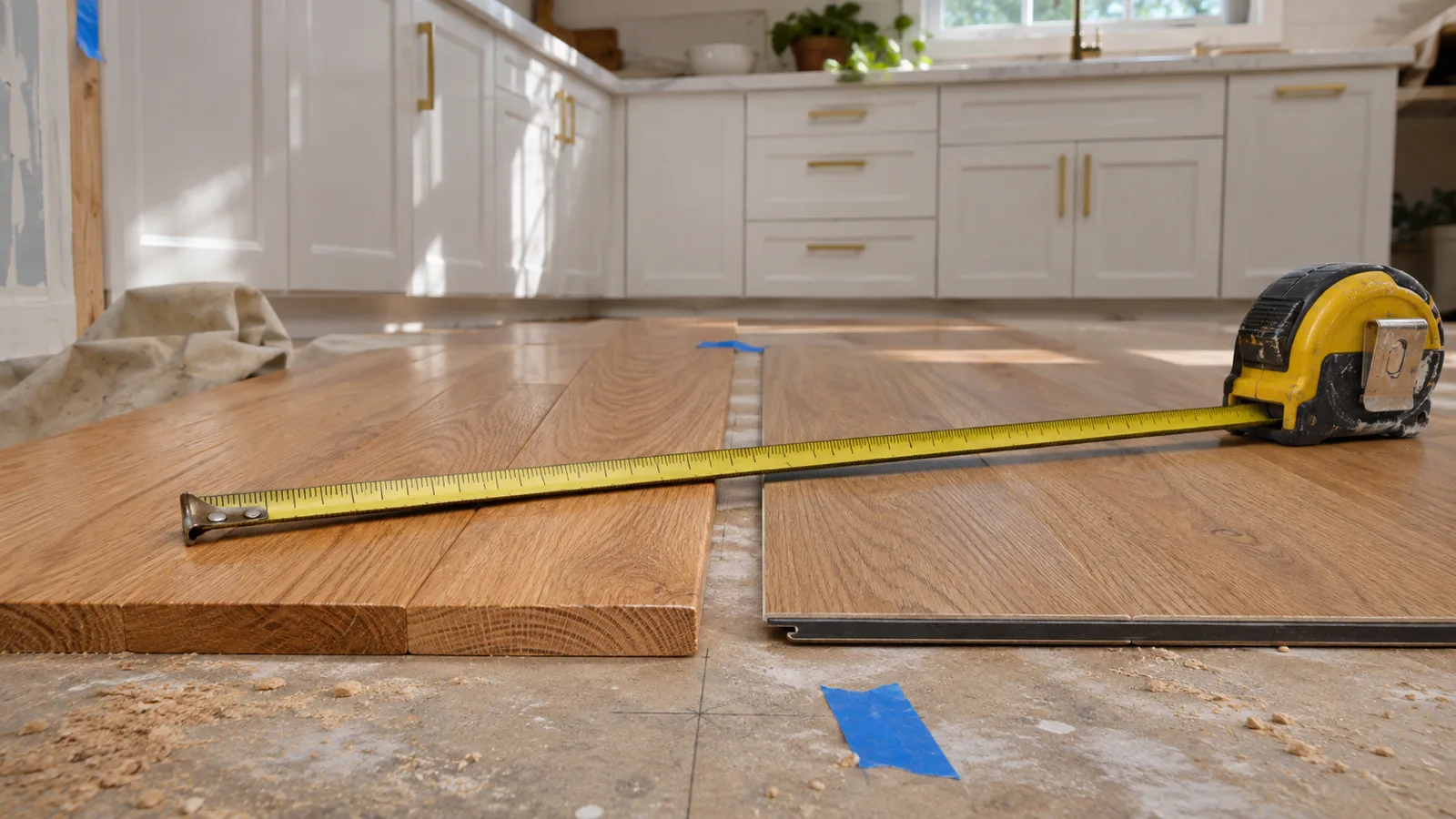
LVP (luxury vinyl plank) with a 20-mil wear layer is the most-installed Lawrenceville kitchen floor in 2026 for good reason: moisture-tolerant, click-together install, and the thicker wear layers handle dog claws and dropped cast-iron pans. It also tolerates the humidity cycling without any dimensional change.
Tile is a 50-year floor and makes sense if you do not mind the cold underfoot in January and the slab is in good shape. We install tile over a decoupling membrane on any Lawrenceville ranch slab with hairline cracks.
Engineered hardwood can work if the slab passes a moisture test. Solid hardwood does not work on a Lawrenceville ranch slab because the humidity cycle will cup the planks within 18 months.
Sealants: 100% silicone, not latex
Latex caulk from the home-aisle shelf at Home Depot fails in 18 months in Lawrenceville humidity. The seal at the sink rim cracks, the backsplash-to-counter joint lets water into the cabinet bottom, and the whole thing has to be re-caulked.
100% silicone caulk costs $2 more per tube and lasts 8 to 10 years. The tube is labeled '100% silicone' on the shelf, and you usually have to look at the construction-supply counter at the back of the store to find it. One of the cheapest upgrades you can make to a DIY kitchen project.
Bottom line
In Lawrenceville, pick plywood cabinet boxes, solid-wood (not thermofoil) doors, quartz counters, epoxy grout on backsplash, 20-mil LVP or tile for flooring, and 100% silicone at every water joint. These picks cost $800 to $1,500 more than the big-box equivalents on a typical mid-range Lawrenceville kitchen remodel and save you from early replacement 10 years out.
If you want a line-item quote with all of these specs called out, give us a call and we will be at your door within 48 hours.